Applications

Adiabatic systems for drycoolers and condensers

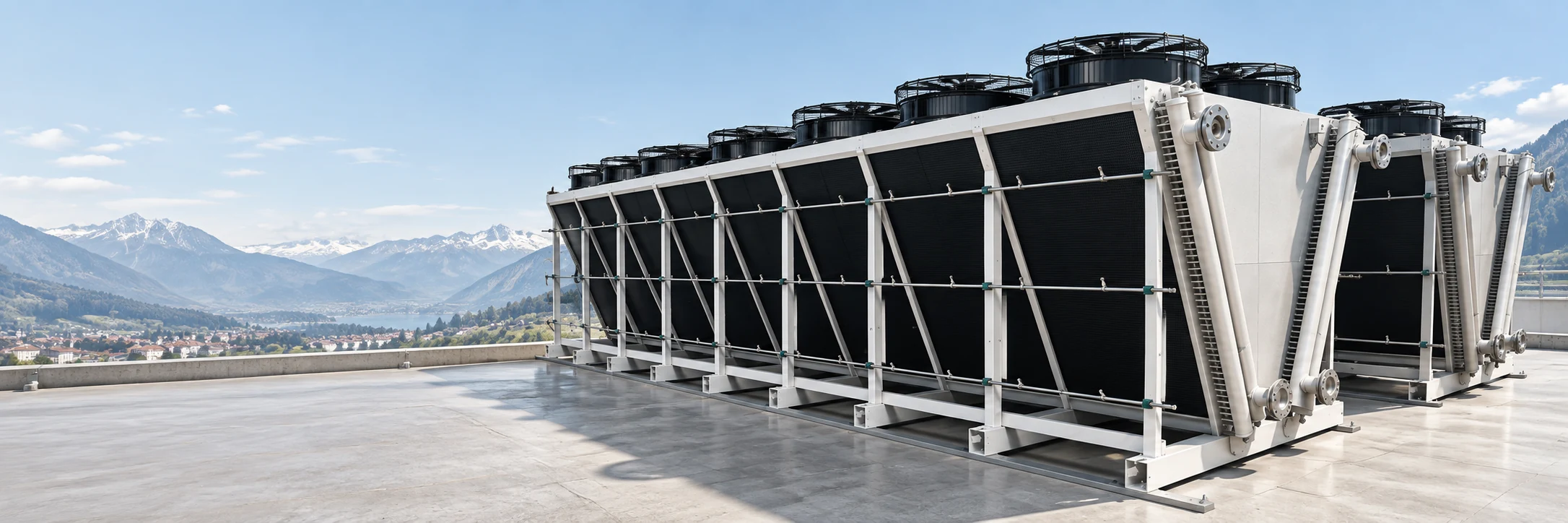
Adiabatic systems increase the performance of drycoolers or condensers during periods characterized by high ambient temperatures.

  • Cooling capacity
  • Water management
  • Precise control

How adiabatic cooling works

The operating principle uses water evaporation to reduce the air temperature before it enters the heat exchanger. The drycooler / condenser can therefore operate with an air temperature lower than the ambient temperature, increasing heat dissipation capacity and allowing the required operating conditions to be maintained even during the hottest periods.

Psychrometric chart of adiabatic air pre-cooling: comparison of HP spray, LP spray and evaporative pads.

Adiabatic technologies and strategies

HP adiabatic systems

HP adiabatic systems

HP high-pressure adiabatic spray systems use specially designed nozzles to atomise water into extremely fine droplets, promoting rapid evaporation in the air drawn into the drycooler or condenser.

Water evaporation removes heat from the air, lowering its temperature before it passes through the heat exchanger and increasing the machine's cooling capacity, particularly during periods of high ambient temperatures.

Thanks to its high atomisation capability, this technology provides effective air pre-cooling, encouraging water to evaporate before it reaches the coil and limiting direct wetting of the heat exchanger.

Operating modes

High-pressure spray systems can be controlled in two modes:

  • ON/OFF: the spray system is fully activated when a specified temperature or cooling-demand threshold is exceeded. This configuration is particularly suited to handling peak thermal loads.
  • Multi-Step: the nozzles are divided into independent groups that are activated progressively according to operating conditions. This control adjusts the amount of sprayed water to actual needs, optimising consumption.

High-pressure systems are particularly suited to applications requiring a temporary increase in drycooler performance, while maintaining fully dry operation whenever adiabatic cooling is not needed.

LP adiabatic systems

LP adiabatic systems

LP low-pressure adiabatic spray systems distribute water through a series of nozzles supplied at relatively low pressures, typically around 3 bar.

Water droplets are introduced into the airflow drawn into the drycooler or condenser. Some of the water evaporates, removing heat from the air and lowering its temperature before it passes through the heat exchanger.

Compared with high-pressure systems, the droplets are generally larger, and some water may reach the coil surface directly, contributing to cooling through evaporation on the heat exchanger surface.

For this reason, water quality, construction materials and any protective coil treatments must be carefully assessed to ensure long-term reliability and durability.

Operating modes

Low-pressure spray systems can also be managed using different activation strategies:

  • ON/OFF: the system is fully activated when operating conditions require an increase in cooling capacity. This is a simple solution, particularly suited to applications with occasional adiabatic cooling requirements.
  • Multi-Step: the nozzles are organised into several independent groups, activated progressively according to ambient temperature or cooling demand. This mode provides more gradual system control and water use proportional to actual needs.

Thanks to their simple construction, low operating pressures and progressively adjustable water delivery, low-pressure spray systems offer a robust, versatile solution. They are also suited to applications requiring relatively prolonged adiabatic operation, provided that water quality and heat exchanger treatment are properly managed.

Adiabatic systems with evaporative pads

Adiabatic systems with evaporative pads

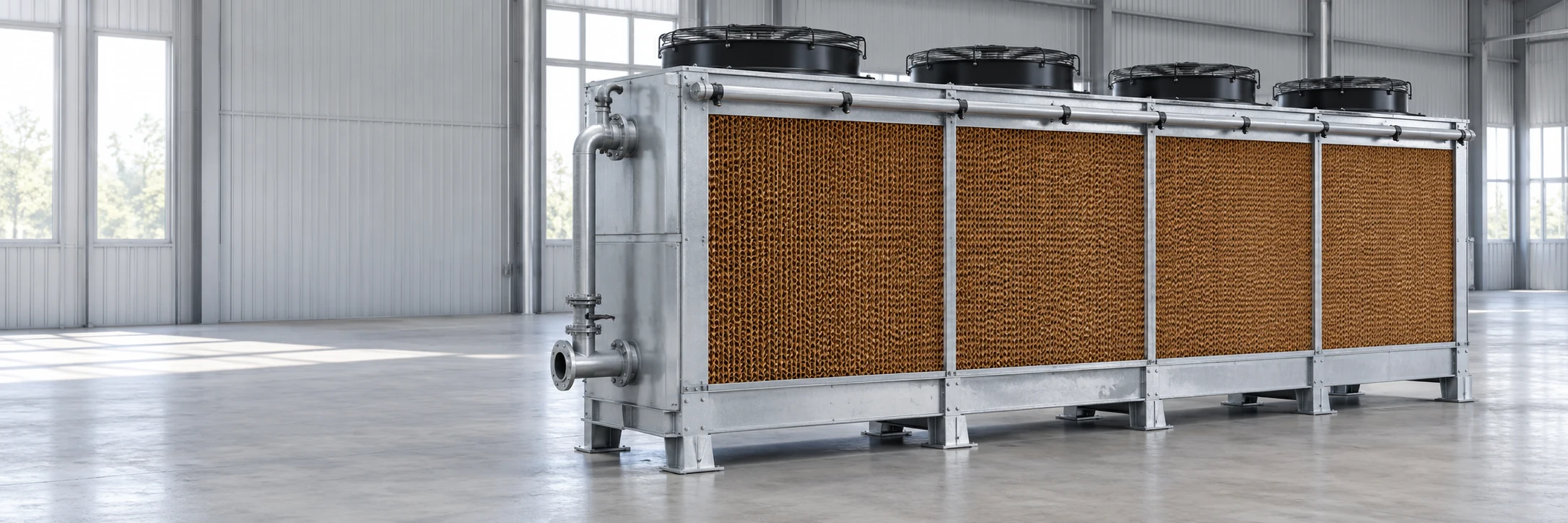
In adiabatic systems with evaporative pads, the air drawn into the drycooler passes through a specially designed surface that is kept constantly wet.

As the air passes through the pad, some of the water evaporates, removing heat from the air and lowering its temperature before it enters the heat exchanger. This allows the drycooler to operate with pre-cooled air, improving performance particularly during periods of high ambient temperatures.

Unlike spray systems, evaporation takes place mainly within the pad itself. This provides effective air cooling before the air reaches the coil, avoiding direct spraying of water towards the heat exchanger.

The large available evaporative surface can achieve high air saturation levels, making this technology particularly suited to applications requiring frequent or prolonged adiabatic cooling.

Water distribution over the pad can be controlled according to operating conditions, while optional recovery and recirculation systems allow unevaporated water to be reused, further reducing consumption.

Evaporative pad systems with water recirculation

Evaporative pad systems with water recirculation

In adiabatic systems with evaporative pads and recirculation, water that does not evaporate as air passes through the pad is collected in a basin and returned to the circuit by a pump. Compared with once-through systems, this solution reduces water consumption by reusing unevaporated water, making operation particularly attractive in applications requiring frequent or prolonged adiabatic cooling.

Recirculation therefore improves overall system efficiency and limits waste while maintaining the typical benefits of evaporative pads: high air pre-cooling capability, no direct water spraying towards the heat exchanger and operation particularly suited to continuous use.

Alongside these benefits, this configuration requires greater attention to water management. Continuous reuse progressively increases the concentration of salts, impurities and dissolved substances, potentially affecting the evaporative pad, collection basin, pump and overall system reliability. Suitable water-quality monitoring is therefore essential, checking parameters such as conductivity, hardness, dissolved solids and the circuit's hygiene conditions.

Integrated adiabatic system management with SC400 and DS400

Related Products

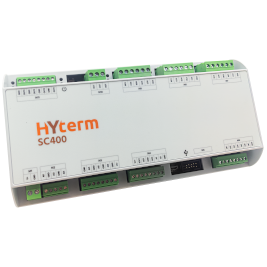
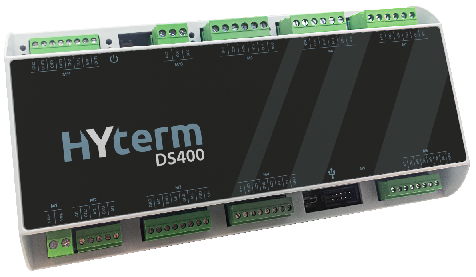
To obtain the greatest benefit from adiabatic systems, activating water only when needed is not enough: adiabatic operation must be continuously and intelligently coordinated with fan control and the machine's actual conditions. For this purpose, Hyterm offers the SC400 and DS400 controllers, dedicated solutions for integrated adiabatic system management.

SC400 and DS400 are designed to control adiabatic systems precisely and reliably, coordinating activation with the unit's overall control logic. Integrated with Hyterm's fan-control range, they harmonise the entire cooling process, simultaneously optimising thermal performance, water consumption and energy consumption.

Integrated management activates the adiabatic system only when operating conditions actually require it, adjusting operation according to ambient temperature, cooling demand and machine status. This approach makes the most of adiabatic pre-cooling, avoiding unnecessary activation and reducing waste.

For spray systems, Hyterm controllers manage ON/OFF or Multi-Step strategies, progressively activating different spray manifolds or sections. For evaporative pad systems, they coordinate water distribution and any auxiliary devices, ensuring operational continuity and optimised control of the adiabatic process.

Using SC400 and DS400 enables more advanced system management, with practical benefits including:

  • better use of the adiabatic effect;
  • optimised water consumption;
  • reduced overall energy consumption;
  • greater stability of machine operation;
  • complete integration of ventilation control and adiabatic control.

References